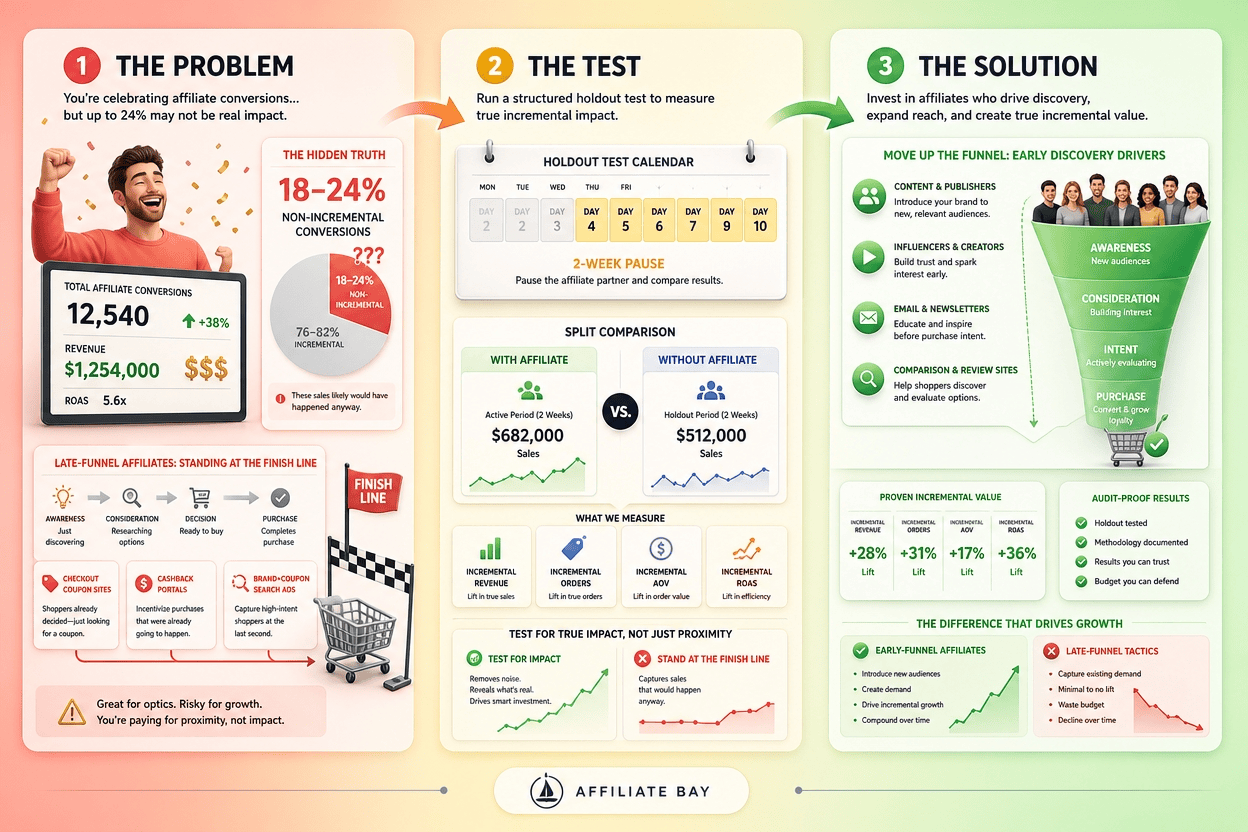

Affiliate fraud costs the industry an estimated $3.4 billion annually. That number gets cited often. Less often discussed is what the fraud actually looks like in 2026, why it has become harder to detect, and what the specific financial exposure is for an average-sized affiliate program.
This article is the honest version of the affiliate fraud conversation — with data from Fraudlogix’s analysis of 105.7 billion ad impressions, Chargebacks911, TrafficGuard, and fraud detection platforms covering real deployment patterns.
Content Outline
Key Affiliate Fraud Statistics 2026
Metric | Number |
Annual cost of affiliate fraud | $3.4 billion |
Global ad fraud total losses | $100+ billion projected by end of 2026 |
Global invalid traffic rate | 20.64% (Fraudlogix, 105.7B impressions analysed) |
US ad spend at risk annually | $37 billion (Fraudlogix) |
Affiliate traffic confirmed as fake | 17% |
Bot traffic in affiliate channels | ~24% |
Cookie stuffing share of affiliate transactions | 5–10% |
Estimated fake leads in affiliate campaigns | Up to 25% |
PPC click fraud rate (average) | 18–22% |
High-risk sector PPC fraud rate | Up to 30% |
Share of brands exposed to influencer fraud | 59.8% |
Enterprise monthly wasted on invalid clicks ($10K/mo budget) | $1,380/month |
The Scale of the Problem
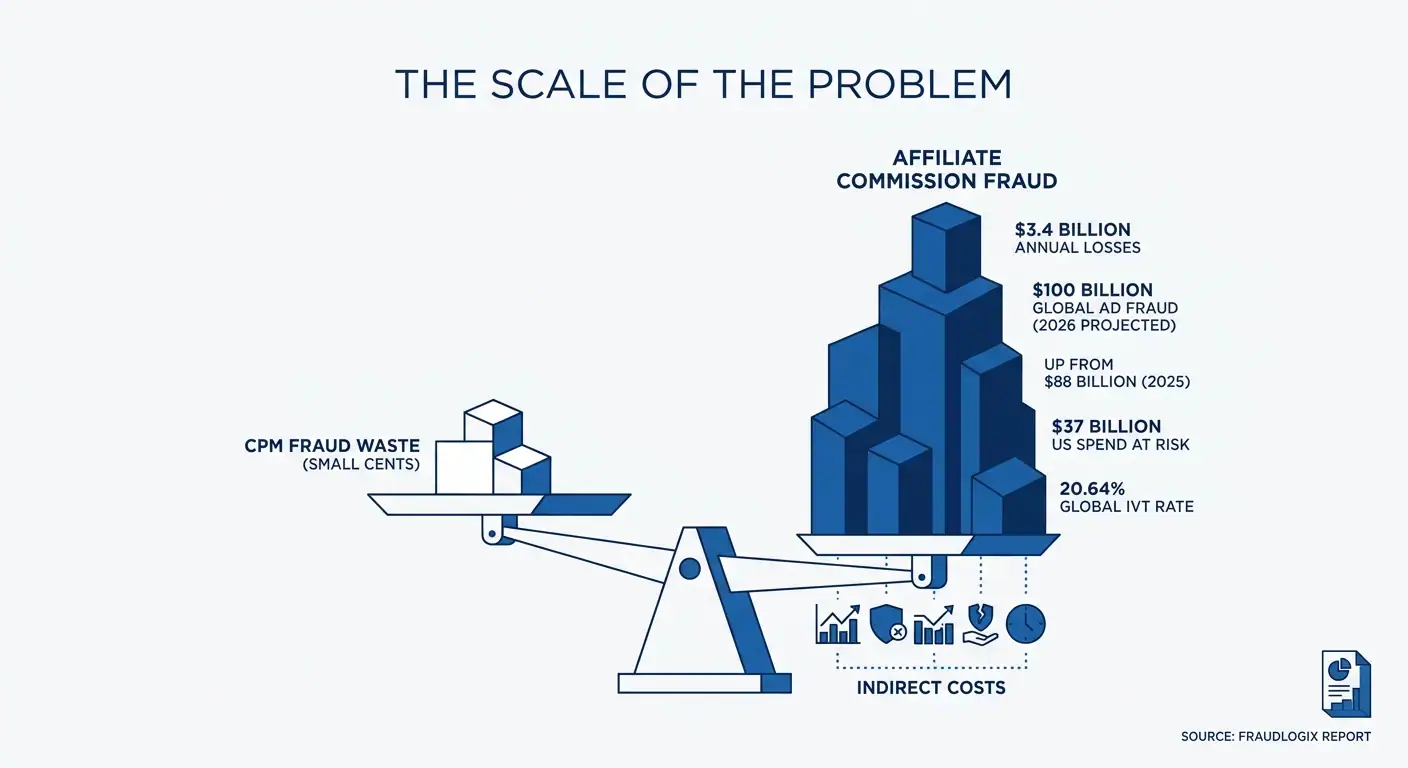
Global ad fraud is projected to exceed $100 billion by end of 2026, up from $88 billion in 2025. Affiliate channels are particularly vulnerable because the commission-based model creates financial incentives for fraud that impression-based channels do not have. A fraudulent click on a display ad wastes a small CPM. A fraudulent conversion in an affiliate program pays a full commission — potentially $50, $100, or more per fake lead.
Fraudlogix’s 2026 State of Ad Fraud Report — based on analysis of 105.7 billion ad impressions — found a 20.64% global invalid traffic rate, with an estimated $37 billion in US ad spend at risk annually. Affiliate channels sit within this broader ecosystem, but with higher per-fraud payouts.
The $3.4 billion annual affiliate fraud figure reflects direct commission losses — money paid out to fraudulent affiliates who generated fake clicks, cookie-stuffed conversions, or fabricated leads. The indirect costs — corrupted analytics, poor strategic decisions based on fraudulent data, staff time investigating anomalies, and erosion of advertiser trust — are not captured in that figure.
The 8 Fraud Types Active in 2026
1. Click Fraud
Automated systems or click farms generate fake clicks on affiliate links to earn per-click commissions or inflate metrics. Modern click fraud uses residential proxies to mimic genuine geographic distribution and behavioural patterns that were easy to detect five years ago.
Average click fraud rate across digital channels: 18–22%
High-risk sectors (legal, insurance, finance, healthcare): up to 30%
More than 1 in 10 clicks on Google Ads is fraudulent (Fraud Blocker data)
2. Cookie Stuffing
Fraudulent affiliates place affiliate tracking cookies on users’ browsers without their knowledge — through hidden iframes, pop-unders, JavaScript injections, or compromised browser extensions. When users later make organic purchases, the fraudster claims the commission.
Cookie stuffing affects 5–10% of affiliate marketing transactions
Remains persistent despite the broader shift from third-party cookies (server-side tracking has reduced some vectors but not eliminated the technique)
Made infamous by the Shawn Hogan/eBay case; the Honey.com controversy in 2024–2025 brought it back to mainstream awareness
The Honey investigation — where a browser extension was found to replace legitimate affiliate cookies with its own at checkout — demonstrated how attribution theft can operate at massive scale while appearing legitimate to advertisers.
3. Click Injection (Mobile)
A malicious app detects when another app is being installed and fires a fake click milliseconds before installation completes, claiming the organic install as an affiliate conversion. Widespread in mobile gaming and app marketing.
Technically sophisticated — fires within milliseconds of a legitimate install event
Impossible to detect without device-level attribution data
Standard in mobile gaming where CPI commissions can be $1–$15 per install
4. Fake Lead Generation
Fraudsters generate fake form fills, email submissions, or sign-ups to earn CPA commissions. Common in insurance, finance, and education affiliate programs.
Up to 25% of leads generated through some affiliate campaigns are estimated to be fake
Fake leads inflate CPA metrics, corrupt contact databases, and result in zero revenue for advertisers
5. Bot Traffic
Automated programs simulate human browsing behaviour, clicking affiliate links and generating fake impressions.
~24% of affiliate marketing traffic comes from bots (Tapper, 2026)
Modern bots use residential proxies, vary timing patterns, and simulate mouse movements to defeat basic detection
AI-assisted bots in 2026 are significantly harder to detect than script-based predecessors
6. Attribution Hijacking
Fraudsters manipulate last-click attribution models to claim commission for conversions they did not drive. Modern versions go beyond cookie stuffing to include click flooding — sending massive volumes of clicks to ensure statistical likelihood of being the last touch before conversion.
The dominant attack type in 2026 according to TrafficGuard analysis
Particularly dangerous because it can affect programs without fraud detection noticing unusual volume
7. Ad Stacking
Multiple ads stacked on top of each other in a single placement — only the top ad is visible but all ads record an impression.
8. AI-Generated Synthetic Traffic
The newest and fastest-evolving threat vector. AI-generated content sites drive bot traffic, and AI-assisted fraud systems adapt to detection patterns in near-real-time, making static rule-based detection increasingly ineffective.
Who Gets Hit Hardest
Not all affiliate programs face equal fraud exposure. The highest-risk programs share certain characteristics:
Risk Factor | Higher Risk | Lower Risk |
Commission per action | High ($50+ per lead) | Low (% of small sales) |
Affiliate vetting | Minimal | Rigorous |
Attribution model | Last-click only | Multi-touch with validation |
Traffic monitoring | Manual/periodic | Real-time automated |
Partner concentration | Few high-volume partners | Diverse partner base |
Niche | Finance, insurance, legal | Low-margin retail |
Financial services affiliate programs face the highest fraud exposure because lead commissions are valuable enough to justify sophisticated fraud infrastructure.
The Hidden Cost: Beyond Direct Losses
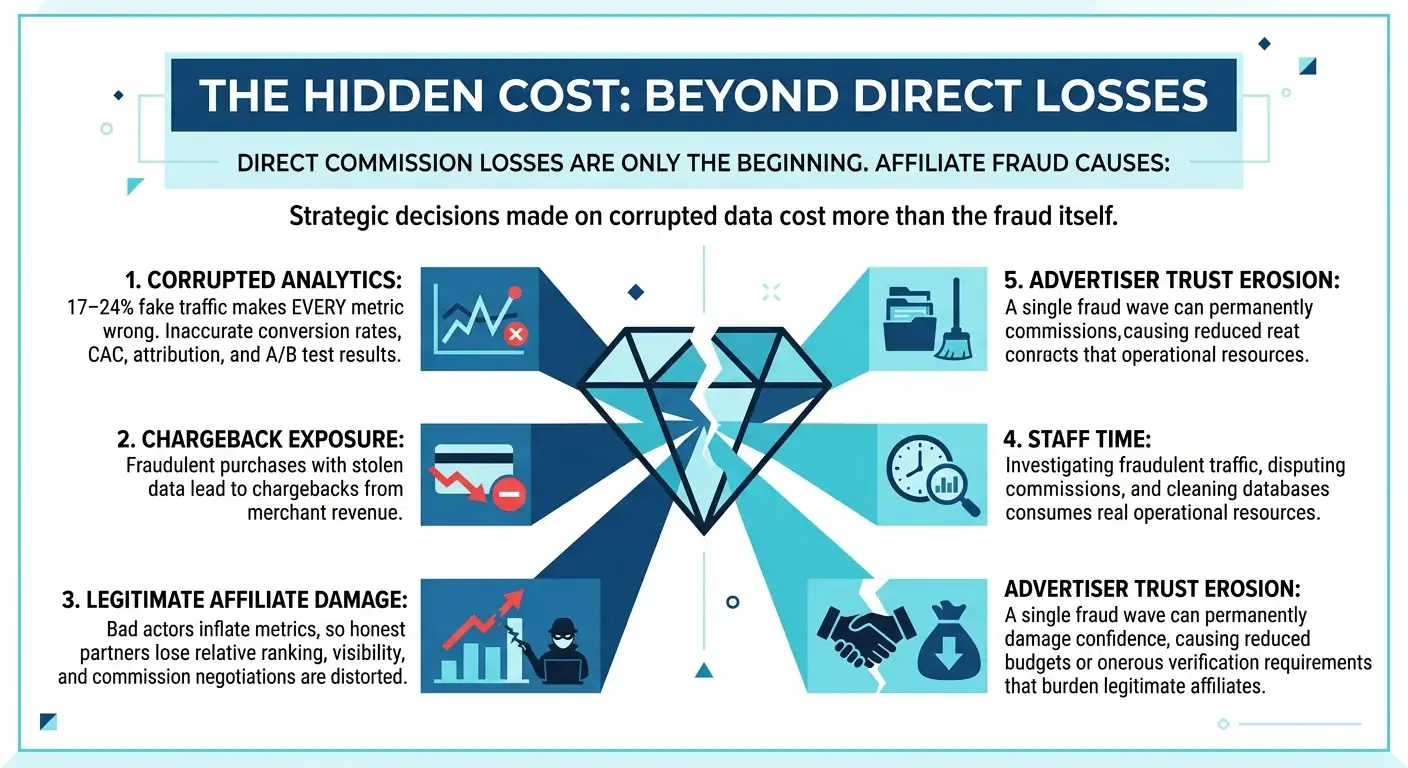
Direct commission losses are only the beginning. Affiliate fraud causes:
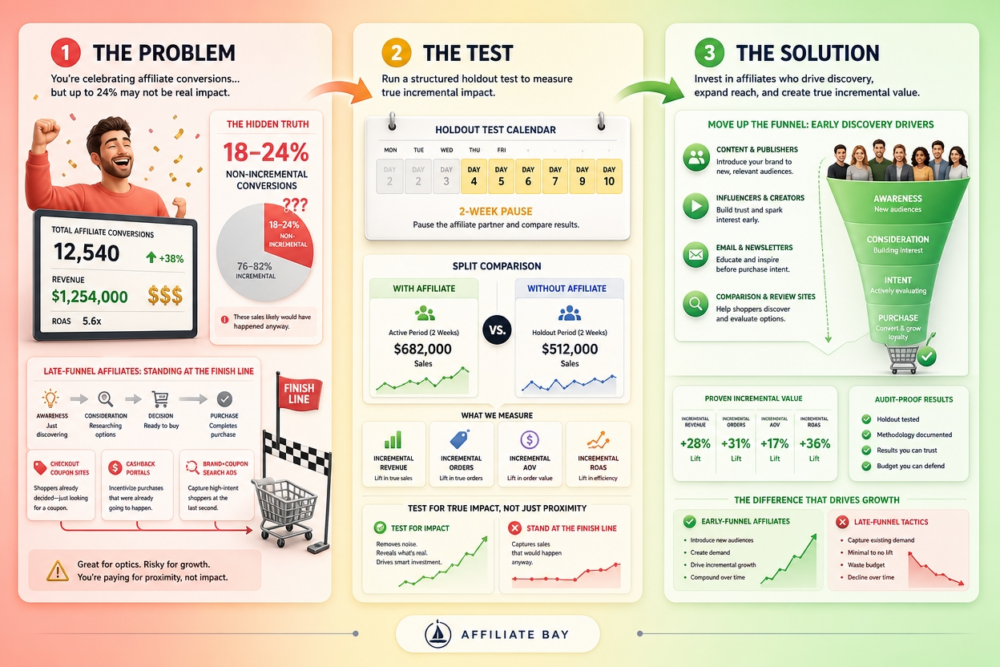
Corrupted analytics: When 17–24% of traffic is fake, every metric derived from that data is wrong — conversion rates, CAC calculations, channel attribution, and A/B test results. Strategic decisions made on corrupted data cost more than the fraud itself.
Chargeback exposure: Fraudulent purchases made with stolen payment data result in chargebacks that come directly from the merchant’s revenue.
Legitimate affiliate damage: When fraud inflates metrics for bad actors, legitimate affiliates lose relative ranking, visibility, and commission negotiations are distorted by fraudulent data.
Staff time: Investigating fraudulent traffic, disputing commissions, and cleaning databases consumes real operational resources.
Advertiser trust erosion: A single wave of fraud can permanently damage an advertiser’s confidence in the affiliate channel, causing them to reduce budgets or add onerous verification requirements that burden legitimate affiliates.
Detection: What Actually Works in 2026
Traditional rule-based detection — IP blacklisting, simple volume anomaly alerts — is no longer effective against modern “low-and-slow” attacks that operate within normal-looking traffic patterns.
Effective 2026 detection approaches:
Method | What It Catches | Limitations |
Real-time traffic scoring | Bot traffic, click farms | Requires baseline data |
Conversion path validation | Cookie stuffing, attribution hijacking | Must compare click timestamp to conversion |
Device fingerprinting | Return visits with different cookies | Adaptive fraud evades this |
Behavioural biometrics | Bot vs human patterns | Computationally expensive |
Session-level validation | Click injection | Requires mobile SDK |
Multi-signal fraud scoring | Comprehensive coverage | Higher implementation complexity |
The emerging 2026 framework — the Luo Framework from academic research — integrates temporal feature extraction (micro-timing between interactions), user interaction pattern recognition (entropy of mouse movements), and anomaly detection algorithms to identify synthetic behaviour that defeats simpler detection.
Leading fraud detection tools by use case:
Voluum Anti-Fraud Kit: Best for affiliate networks managing high volume
TrafficGuard: Strong for enterprise programmes with complex attribution
Anura: Comprehensive real-time blocking
Fraudlogix: Large-scale impression-level analysis
CAKE: Built-in fraud detection within the affiliate management platform
Everflow: Fraud detection integrated with programme management
Prevention: Programme-Level Controls
Detection tools handle the traffic layer. Programme-level controls handle the partner layer.
Partner vetting:
Manual application review before approval
Tiered trust levels — new partners start with limited access
Documented promotional method requirements for each partner
Clear policy banning cookie stuffing, brand bidding, automated clicks, and incentivised traffic
Consequences explicitly stated: immediate termination and commission forfeiture
Attribution controls:
Short validation windows prevent late-stage attribution manipulation
Partner and device frequency caps limit high-volume manipulation
Session-level validation confirms genuine user engagement before commission credit
Industry intelligence networks:
TAG (Trustworthy Accountability Group) — shared database of known fraudulent actors
MRC (Media Rating Council) — maintained fraud IP and domain lists
FAQs
Affiliate fraud causes $3.4 billion in direct commission losses annually, with total ad fraud projected to exceed $100 billion industry-wide in 2026. The US alone has an estimated $37 billion in ad spend at risk each year across affiliate, display, and paid search channels.
Cookie stuffing secretly places affiliate tracking cookies on users' browsers without their knowledge, stealing attribution from legitimate affiliates and billing merchants for conversions they earned organically. It affects 5–10% of affiliate transactions and remains a serious threat in 2026 by exploiting server-side tracking vulnerabilities, even as third-party cookies decline.
Industry analysis confirms that 17% of affiliate traffic is fake, while bot traffic accounts for roughly 24% of all affiliate channel activity. In some programmes, up to 25% of submitted leads are estimated to be fraudulent.
Key red flags include affiliates with unusually high click-to-sale ratios, sudden overnight traffic spikes, session durations under five seconds, and conversion path timing that does not match normal user behaviour. Real-time fraud detection tools can provide continuous monitoring to catch these patterns early.
Fraudsters continuously adapt their methods, shifting from browser-based exploits to server-side tracking vulnerabilities as cookie-based attribution becomes less reliable. The scale of financial incentive — billions of dollars in commissions — ensures that sophisticated fraud operations keep evolving faster than many standard detection measures.