
The choice between CPA (cost per acquisition) and revenue share is one of the most consequential decisions in affiliate marketing — for both programme managers and affiliates. It determines how risk is distributed, how long the revenue relationship lasts, and what each party’s incentives are.
Most articles on this topic give you the theory. This one gives you the data — benchmarks by vertical, long-term performance comparisons, and the specific numbers that show where each model wins and where it loses.
Content Outline
Quick Reference: CPA vs RevShare at a Glance
Dimension | CPA | Revenue Share |
Payment timing | Immediate (on conversion) | Ongoing (% of revenue) |
Affiliate risk | Low — paid immediately | Higher — depends on customer retention |
Advertiser risk | Higher — pays regardless of LTV | Lower — aligns with actual revenue |
Long-term earning potential | Capped at one-time payment | Compounds with customer base |
Best for affiliate with | Traffic focus, quick monetisation | Content authority, retained audience |
Best for advertiser with | High average order value | High customer LTV, low churn |
Revenue growth over 36 months | Lower | 3.4x higher (SaaS recurring data) |
Higher (one-time payment incentivises fake conversions) | Lower (ongoing relationship) |
The 36-Month Revenue Comparison
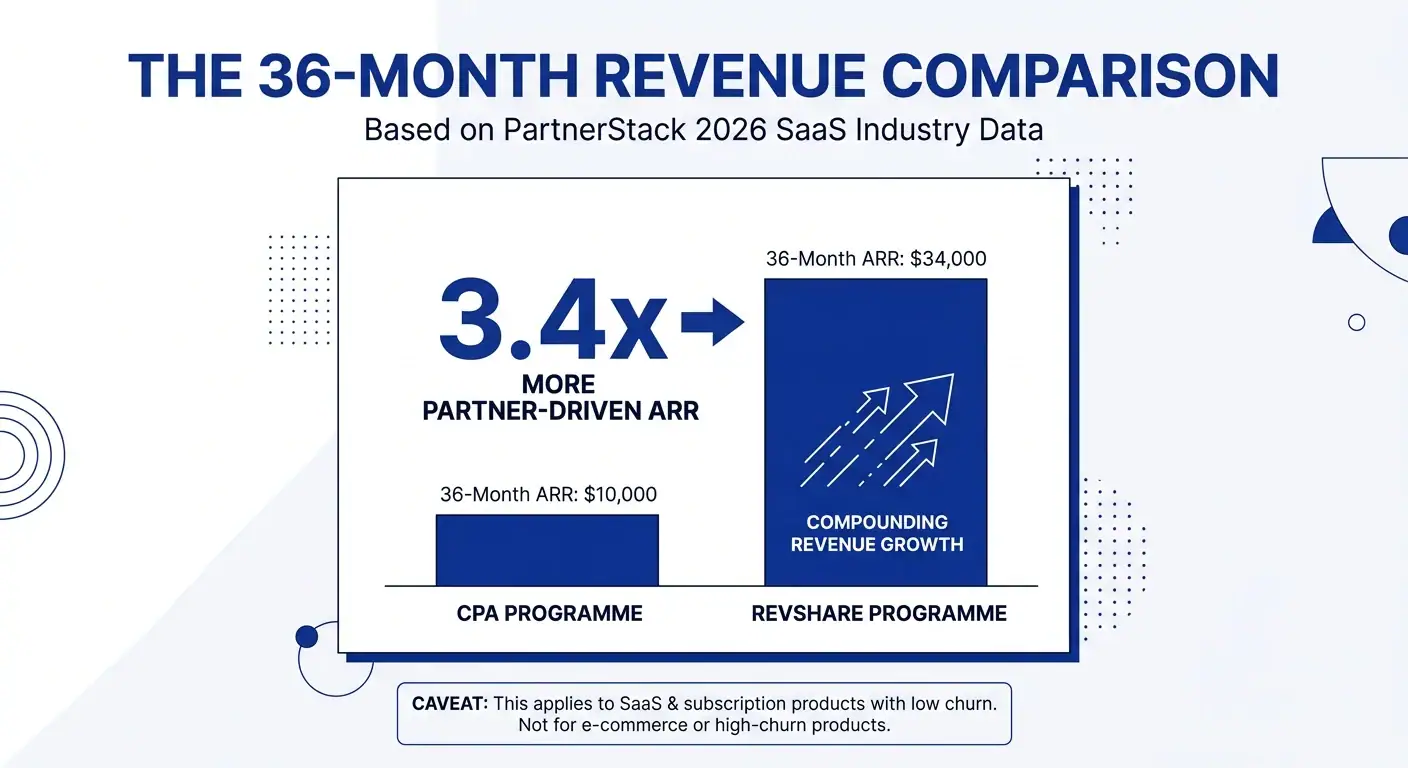
The single most important statistic in the CPA vs RevShare debate comes from PartnerStack’s 2026 industry data on SaaS affiliate programmes:
Recurring revenue programmes generate 3.4x more partner-driven ARR over 36 months than equivalent one-time-bounty programmes at the same blended customer-acquisition cost.
This is not a small difference. At $10,000 in partner-driven revenue from a CPA programme over 36 months, an equivalent RevShare programme on SaaS generates $34,000. The compounding effect of monthly recurring commissions over a 3-year period overwhelms the immediate payment advantage of CPA.
The caveat: this applies specifically to SaaS and subscription products with reasonably low churn. For e-commerce where customers make one-time purchases, or for high-churn products, CPA can be the better economic outcome.
Commission Rates by Model and Vertical: 2026 Data
Vertical | CPA Range | RevShare Rate | Notes |
SaaS (subscription) | $50–$300 per signup | 20–30% first year, 10–15% thereafter | PartnerStack: 71% of SaaS programmes pay recurring |
E-commerce | $5–$50 per sale | 5–15% of sale value | Mostly CPA in practice |
Finance (lead-gen) | $30–$200 per lead | Not standard | Lead quality drives rate |
iGaming | €25–€150 CPA | 25–45% net gaming revenue | RevShare dominates long-term |
Travel | Flat fee or % | 4.2% median | Commission junction data |
Health/wellness | $10–$100 per sale | 6–15% | Mix of both |
Hosting/SaaS | $50–$200 per signup | 30% recurring common | Established market |
Education/e-learning | $20–$100 per enrol | 20–40% of course price | High variance |
The most important data point for affiliates considering programme selection: 71% of SaaS affiliate programmes now pay recurring commissions (PartnerStack 2026). The SaaS affiliate market has moved decisively toward recurring models because the math is compelling for both sides.
iGaming: The Vertical Where RevShare Dominates
iGaming is the vertical where the CPA vs RevShare question is most actively debated and most data-rich. The numbers illustrate why RevShare is the long-term winning model for affiliates with retained, high-quality traffic.
iGaming commission ranges:
Player Quality | CPA Rate | RevShare Rate | Annual Estimated Value |
Standard player | €25–€75 | 25–35% NGR | €100–€500 over lifetime |
High-value player | €100–€150+ | 35–45% NGR | €1,000–€10,000+ over lifetime |
Very high-value player | Negotiated | 35–50% NGR | Can reach six figures over lifetime |
NGR = Net Gaming Revenue (gross gaming revenue minus bonuses and chargebacks)
Why most iGaming affiliates eventually prefer RevShare:
A player acquired at a €50 CPA who plays actively for 3 years generates significantly more in RevShare commissions than the one-time payment. At a 35% RevShare on a player who generates €200/month in net gaming revenue, the affiliate earns €70/month — recovering the €50 CPA equivalent in under one month and continuing to earn for years.
The risk with RevShare: negative carryover. Some programmes apply a player’s losses against wins and carry negative balances into the next month. When a player wins big, the affiliate’s RevShare goes negative — and in programmes with negative carryover, that debt must be paid off before the affiliate earns again. Always check whether a programme uses negative carryover before selecting RevShare.
When CPA Wins
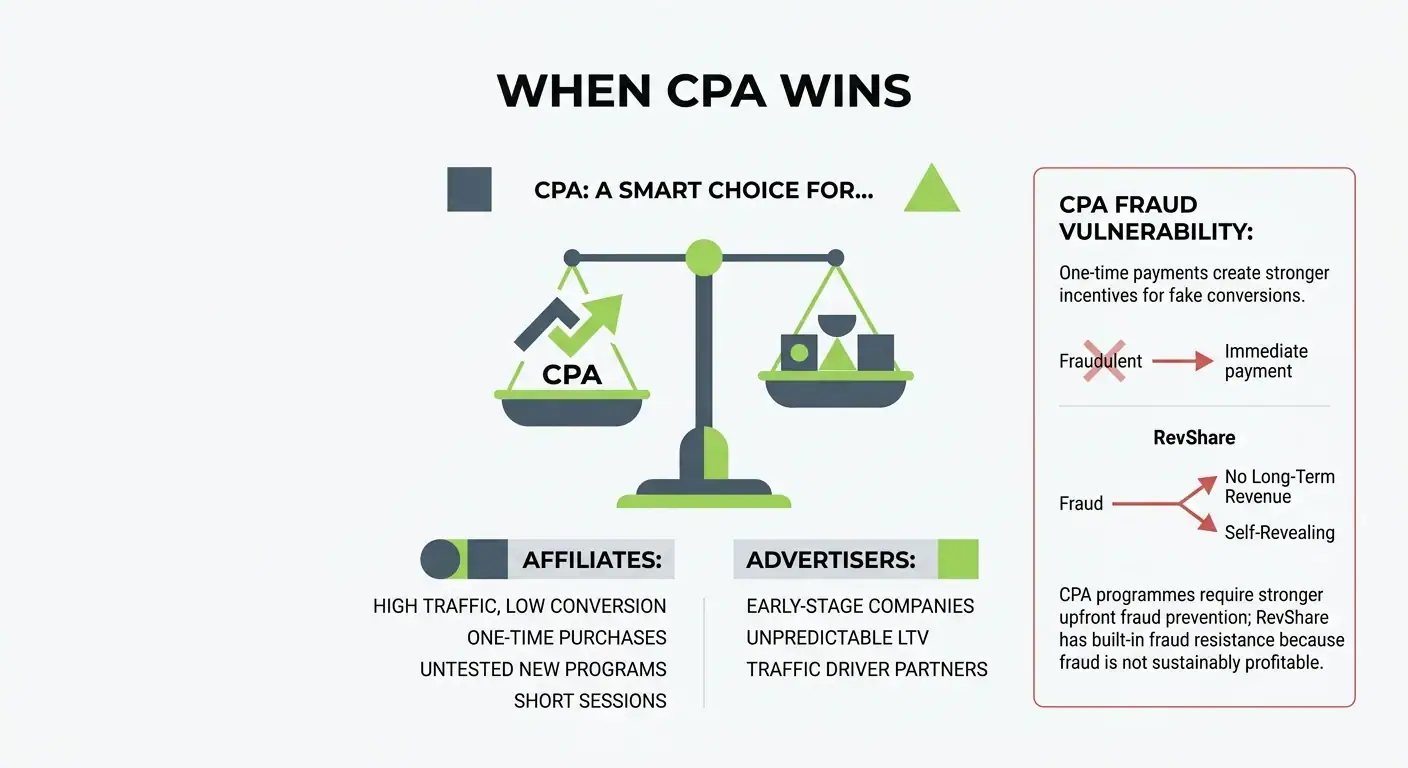
CPA is the better choice in specific scenarios:
For affiliates:
High traffic volume with lower conversion rates — CPA guarantees payment per conversion regardless of subsequent customer behaviour
Campaigns targeting one-time purchase products where customers are unlikely to return
New programmes where you cannot assess operator quality or customer retention before recommending
Traffic sources with shorter session times where building the long-term relationship required for RevShare to compound is impractical
For advertisers:
Early-stage companies that cannot sustain ongoing commission payments against uncertain revenue
Products with unpredictable LTV where RevShare risk is too high to model
Affiliate partners who are primarily traffic drivers rather than audience holders — where one-time payment aligns better with the partnership nature
The CPA fraud vulnerability: One-time payments create stronger incentives for fake conversions than RevShare. A fraudulent affiliate earning RevShare on fake customers generates no long-term revenue — the fraud is self-revealing. A fraudulent affiliate earning CPA on fake signups gets paid immediately and disappears. CPA programmes require stronger upfront fraud prevention; RevShare programmes have built-in fraud resistance because fraud is not sustainably profitable.
Hybrid Models: Getting the Best of Both
The industry’s practical answer to the CPA vs RevShare question is increasingly “both.” Hybrid models combine elements of each.
Common hybrid structures:
CPA + Reduced RevShare: Pay a lower upfront CPA plus ongoing RevShare at a lower rate than a pure RevShare deal
CPA with RevShare conversion: Start with CPA until the affiliate demonstrates quality, then convert top performers to RevShare
Tiered hybrid: CPA for first 30 days of customer activity, RevShare thereafter
Baseline CPA + performance bonus: Fixed CPA with RevShare bonus if customer meets activity thresholds
The iGaming hybrid example:
€30 CPA per player (reduced from standard €75)
Plus 25% RevShare ongoing (reduced from standard 35%)
Net effect: Affiliate earns immediately (reducing risk) while operator caps worst-case cost exposure
Hybrid for SaaS:
$50 one-time CPA per trial signup
Plus 15% recurring commission on each monthly payment
Creates immediate affiliate motivation while building long-term compound income
Performance Data: What the Research Shows
Long-term earning comparison (SaaS, 36 months):
Model | Year 1 Earnings | Year 2 Earnings | Year 3 Earnings | Total (36 months) |
CPA ($150 per signup) | $15,000 (100 signups) | $15,000 | $15,000 | $45,000 |
RevShare (20% recurring, $50/mo avg) | $12,000 | $14,400* | $17,280* | $43,680* |
RevShare (with churn factored) | $10,000 | $9,500 | $9,025 | $28,525 |
*Note: Pure RevShare outperforms CPA over 36 months only when churn is low enough that the base grows. At typical SaaS churn rates (3–5% monthly), the compounding advantage can be partially offset. The 3.4x PartnerStack figure reflects programmes with strong retention.
The key variable is customer retention quality. Affiliates who drive high-quality, well-matched customers to high-retention SaaS products see the RevShare compound significantly. Affiliates driving mismatched or low-intent customers see RevShare perform below CPA.
Choosing the Right Model: Decision Framework
Choose RevShare when:
You have a sustained, retained audience with genuine interest in the product
The product has demonstrably low churn (under 3% monthly)
You plan a long-term relationship with the programme
You can afford to wait for the compounding income to build
Choose CPA when:
Your traffic source is transactional or has high turnover
You need immediate revenue certainty
You cannot assess operator quality before committing
Your audience alignment with the product is uncertain
Negotiate hybrid when:
You have leverage (high traffic quality, established audience)
The programme offers flexibility
You want immediate income AND long-term upside
FAQs
RevShare pays significantly more over a 36-month period when customer retention is reasonable, with PartnerStack data showing 3.4x more partner-driven ARR for recurring programmes versus CPA. The main exception is high-churn products, where CPA is better because it locks in value before customers cancel.
Most SaaS programmes offer 20–30% of first-year revenue, dropping to 10–15% for months 13–24 and declining further after that. Programmes offering 30%+ recurring with no decline curve are rare and typically signal either high product margins or aggressive affiliate recruitment strategies.
Negative carryover means a player's winning month creates a deficit that must be paid off from your future commissions before you earn again. Programmes without negative carryover reset each month, making them far more affiliate-friendly, so always check this clause before signing any iGaming RevShare deal.
Some programmes do allow a switch, but it typically requires direct negotiation rather than a simple settings change. Affiliates with proven traffic quality and volume have the strongest leverage to request a model change.
Converting high-performing CPA affiliates to RevShare is a common advertiser retention tactic because it creates longer-term partnership incentives and reduces the risk of affiliates jumping to competing offers. It also aligns affiliate earnings with customer lifetime value rather than just acquisition volume.