
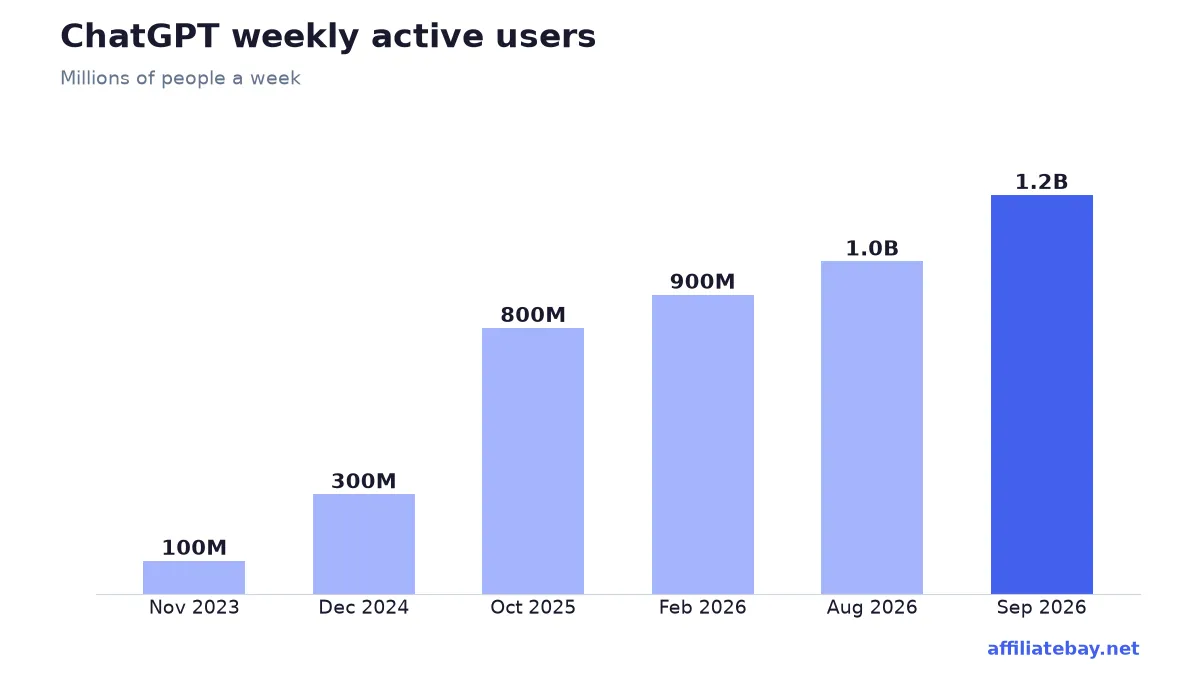
AI chatbot statistics for 2026 start with one giant number. ChatGPT now reaches 1.2 billion people every week, more than any other chatbot.
Adoption runs deep in daily life too. About 49% of US adults use AI chatbots, and the chatbot market is worth an estimated $11.8 billion in 2026.
Below, these AI chatbot statistics cover usage, market size, industries, costs, regions, risks and forecasts.
AI Chatbot Statistics 2026 (Key Highlights)
- ChatGPT has 1.2 billion weekly active users in 2026.
- The Gemini app has passed 1 billion monthly active users in 2026.
- The global chatbot market is estimated at $11.8 billion in 2026.
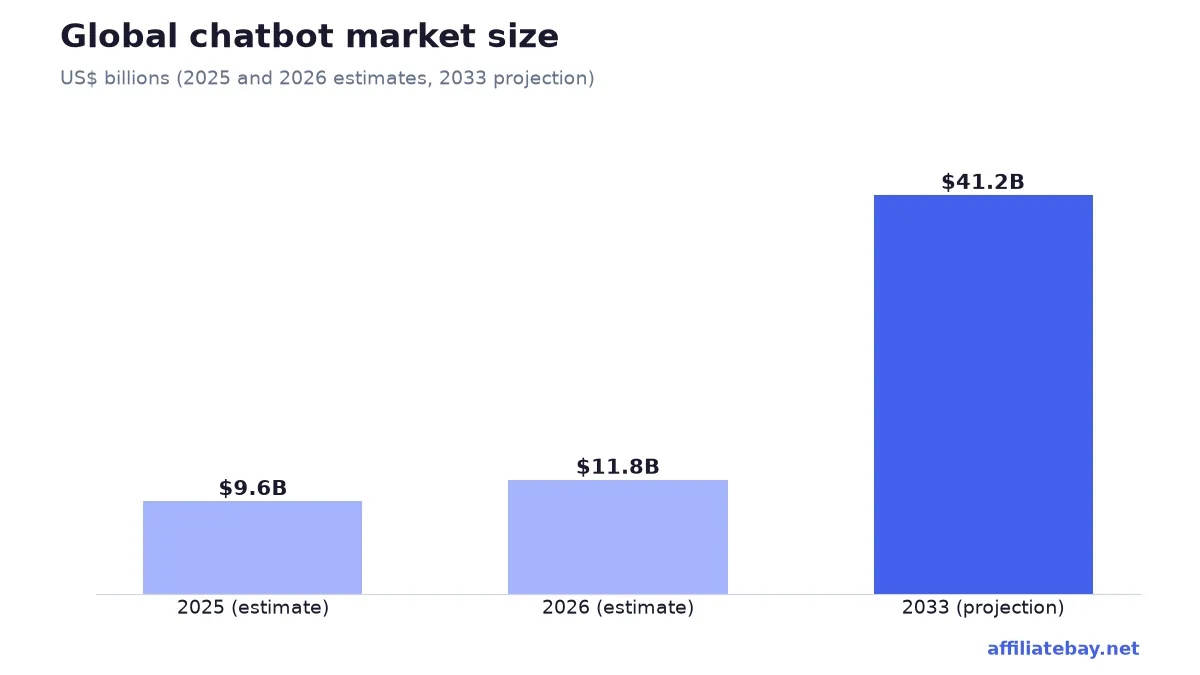
- The chatbot market is projected to reach $41.2 billion by 2033, growing 19.6% a year.
- 49% of US adults use AI chatbots in 2026, up from 33% in 2024.
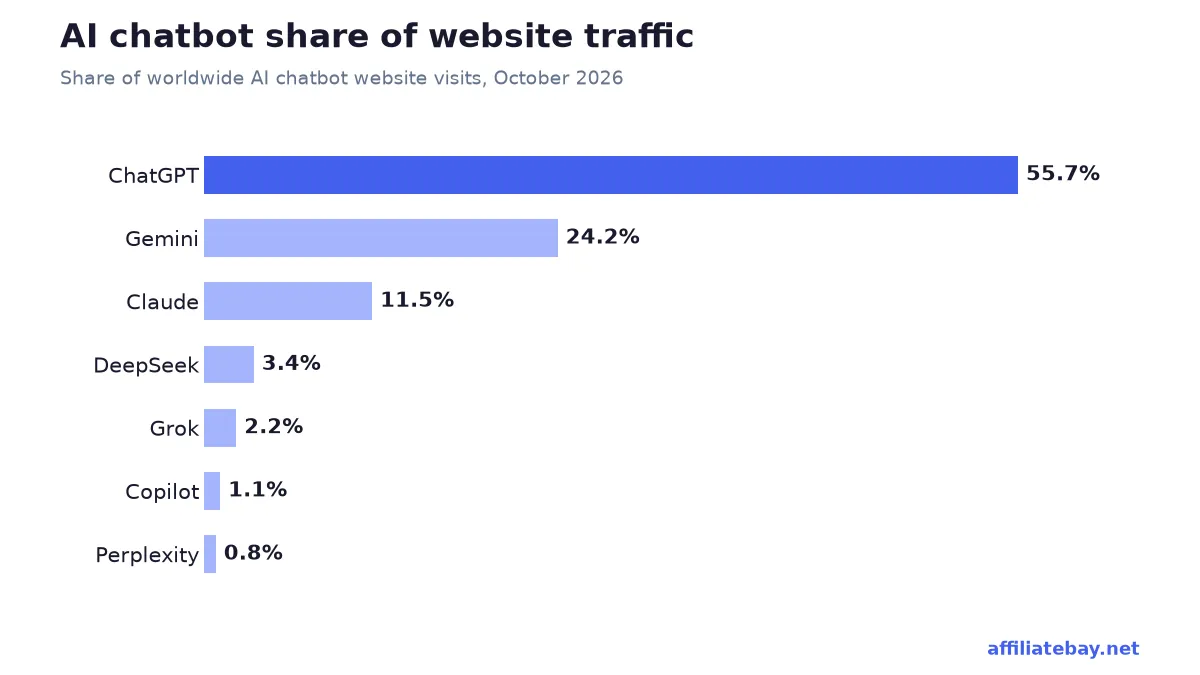
- ChatGPT holds 55.7% of AI chatbot website traffic worldwide.
- Only 27% of customers would try a company chatbot again after a bad experience.
- 87% of customers want a way to reach a human when a company uses AI for service.
How Many People Use AI Chatbots?
ChatGPT alone reaches 1.2 billion people a week, and three chatbots count audiences near or above 1 billion. ChatGPT grew from 100 million weekly users in late 2023 to 1.2 billion in 2026. The Gemini app reached 1 billion monthly users this year, and Meta AI passed 1 billion monthly users in 2025. Each brand counts its audience differently, so these AI chatbot statistics should never be added together.
| AI chatbot | Latest user count | Measured as |
|---|---|---|
| ChatGPT | 1.2 billion | People a week |
| Meta AI | More than 1 billion (2025) | People a month |
| Gemini app | 1 billion | People a month |
| Microsoft Copilot | More than 150 million (2025) | People a month |
| Grok | About 117 million | People a month |
What this means: these AI chatbot statistics show your readers already use a chatbot. Write for people who know the basics.
Which AI Chatbot Is the Most Popular?
ChatGPT draws 55.7% of all AI chatbot website traffic, more than double any rival. Gemini ranks second with 24.2%, and Claude is third with 11.5%. A year earlier, ChatGPT held 69.5% and Claude only 2.1%. These AI chatbot statistics count website visits only, not app use. For the bigger picture, see our OpenAI vs Anthropic vs Google AI company comparison.
| AI chatbot | Share of web traffic |
|---|---|
| ChatGPT | 55.7% |
| Gemini | 24.2% |
| Claude | 11.5% |
| DeepSeek | 3.4% |
| Grok | 2.2% |
| Copilot | 1.1% |
| Perplexity | 0.8% |
What this means: AI chatbot statistics on traffic show ChatGPT still leads, but its share fell almost 14 points in a year. Do not bet everything on one platform.
AI Chatbot Market Size: How Big Is the Chatbot Market?
The global chatbot market is estimated at $11.8 billion in 2026, up from $9.6 billion in 2025. That is a jump of about 23% in one year, one of the fastest gains in these AI chatbot statistics. Ready made chatbot software takes 61.8% of the money. The chatbot boom rides a bigger AI wave, which our machine learning statistics page tracks.
| Year | Chatbot market size |
|---|---|
| 2033 (projection) | $41.2 billion |
| 2026 (estimate) | $11.8 billion |
| 2025 (estimate) | $9.6 billion |
What this means: the market is still young, so new tools and new affiliate offers have plenty of room to grow.
What Do People Use AI Chatbots For?
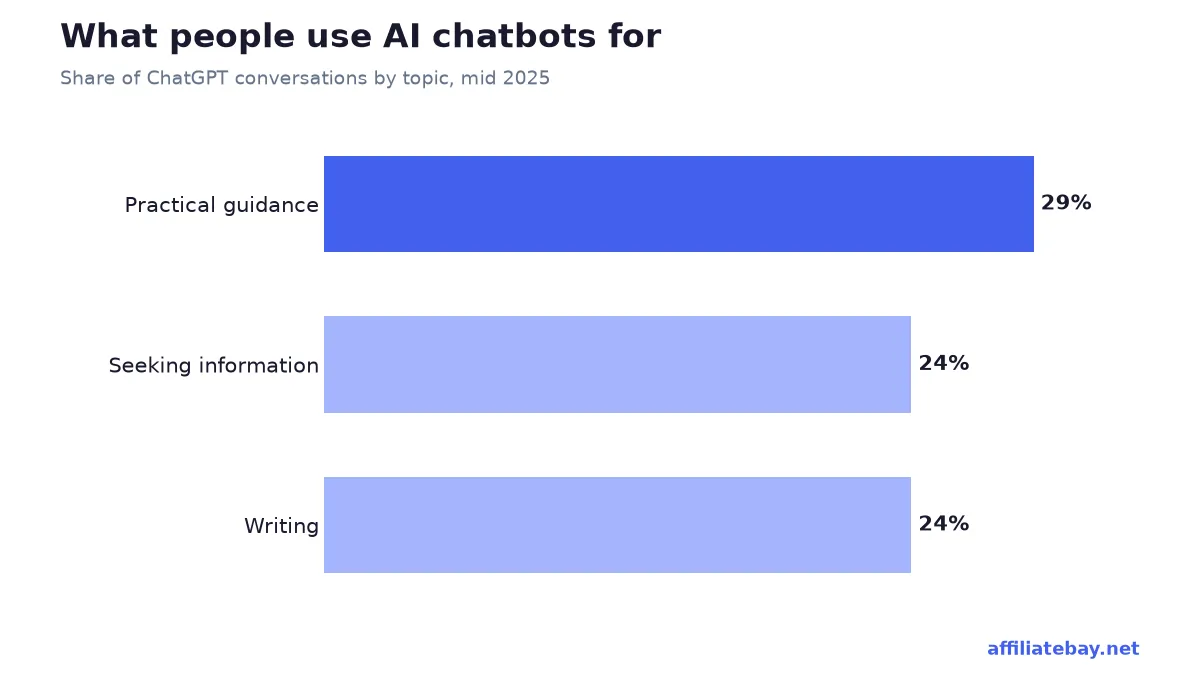
73% of ChatGPT messages were about life outside work by mid 2025, up from 53% a year earlier. AI chatbot statistics on use cases show practical guidance leads at about 29% of conversations. Seeking information and writing follow at about 24% each. Writing still rules at work, with 40% of work messages.
Did you know?
A slight majority of ChatGPT users now appear to be women. By mid 2025, 52% had typically feminine first names, up from 37% in early 2024. Promoting AI apps to this crowd? Our guide to the best AI tools affiliate programs shows which ones pay the most.
- About 300 million people a week ask ChatGPT about health and wellness.
- About 200 million people a week use it for personal finance.
- 250 million people a week talk to ChatGPT by voice.
What this means: chatbots moved from office helper to everyday adviser. Content on health, money and life questions matches real demand.
AI Chatbot Statistics by Industry
Retail and ecommerce hold the largest share of chatbot market revenue. Shops use chatbots to answer product questions, track orders and save abandoned carts. Customer service is the top use case in every industry, and mobile apps are the biggest channel. See how online stores are changing in our ecommerce statistics roundup.
| Market segment leader | Share of chatbot revenue |
|---|---|
| Ready made software | 61.8% |
| Standalone chatbots | 58.2% |
| North America (region) | 31.3% |
What this means: in retail, a chatbot is now table stakes. The edge comes from how well it answers.
AI Chatbot Customer Service Statistics
Only 7% of customers used a company chatbot in their latest service contact, though 49% were willing to. Customers are about three times more likely to ask an outside AI tool than a company chatbot. Half of customers say service feels easier when AI is involved. Brands comparing support tools can start with our list of AI customer service chatbot affiliate programs.
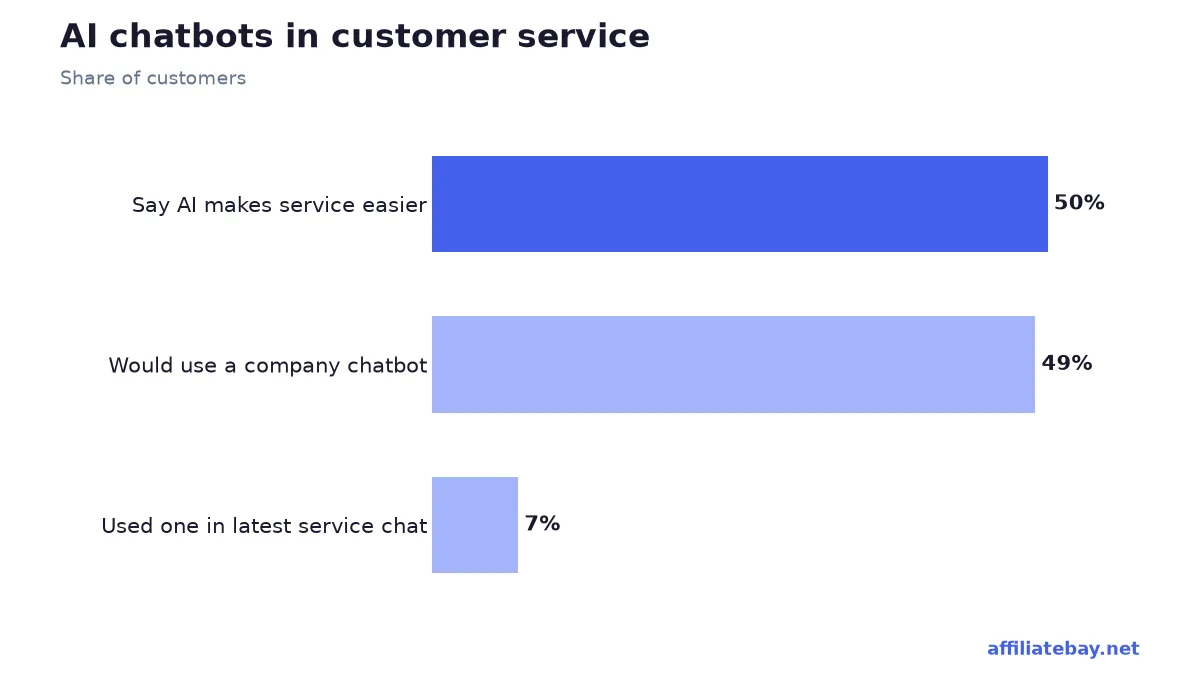
What this means: the gap between 49% and 7% is a trust problem. A support bot must solve the issue fast, or people leave.
AI Chatbot Revenue Statistics: How Much Do Chatbot Companies Make?
The maker of Claude earned about $17 billion in one quarter of 2026, and the maker of ChatGPT passed $10 billion. Anthropic earned $33.24 billion in the first nine months of 2026, about 12 times its total a year earlier. OpenAI posted its first $10 billion quarter, and its enterprise business doubled in three months. These totals cover each company’s whole business, not only chatbot plans.
| Company | Main chatbot | Third quarter revenue, 2026 |
|---|---|---|
| Anthropic | Claude | About $17 billion |
| OpenAI | ChatGPT | About $10 billion |
What this means: business buyers drive a big slice of chatbot money. Tools for teams and developers have deep pockets behind them.
What Are the Benefits of AI Chatbots?
58% of people who use generative AI have had it complete a task for them. AI chatbot statistics on benefits show that share climbs to 74% in business settings. People use chatbots to book appointments, place orders and update accounts. Speed and round the clock help are the big draws.
| Benefit | Share |
|---|---|
| Business users who had AI complete a task | 74% |
| All generative AI users who had AI complete a task | 58% |
| Customers who say AI makes service easier | 50% |
What this means: chatbots that take action win. A bot that books or fixes beats one that only chats.
How Much Do AI Chatbots Cost?
Most major AI chatbots are free to start, and the standard paid plan costs about $20 a month. AI chatbot statistics on pricing show budget plans from $4.99 a month and top plans up to $500. Service teams put a median 12% of their 2025 budget into AI. Only 24% of those leaders can show a positive financial return so far.
| Plan (US) | Monthly price |
|---|---|
| ChatGPT Pro | $100 to $500 |
| Claude Max | $100 |
| Google AI Ultra | From $99.99 |
| ChatGPT Plus | $20 |
| Claude Pro | $20 |
| Google AI Pro | $19.99 |
| ChatGPT Go | $8 |
| Google AI Plus | $4.99 |
| Free tiers | $0 |
What this means: for most people the $20 tier is plenty. Companies should track returns from day one.
Who Uses AI Chatbots the Most? (AI Chatbot Statistics by Age)
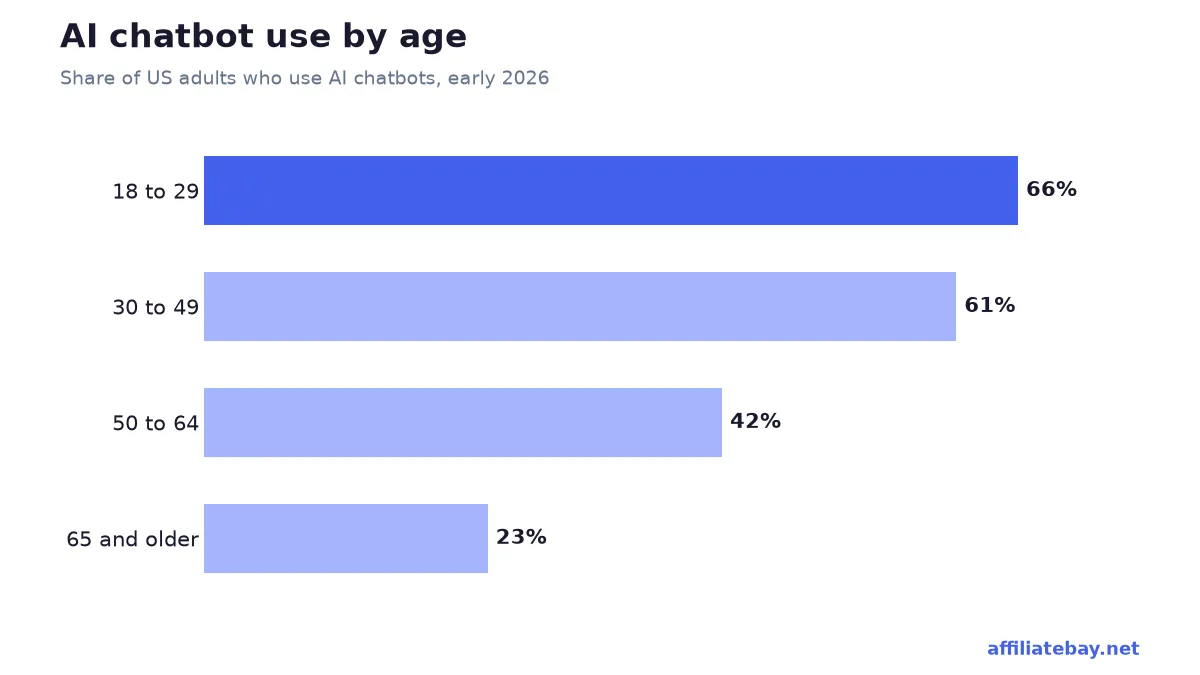
66% of US adults aged 18 to 29 use AI chatbots, compared with 23% of adults 65 and older. Adults in their 30s and 40s have nearly caught up, at 61%. About a third of adults under 50 use a chatbot every day. AI chatbot statistics by age show use rising in every group since 2024.
| Age group | Use AI chatbots | Use them daily |
|---|---|---|
| 18 to 29 | 66% | 31% |
| 30 to 49 | 61% | 34% |
| 50 to 64 | 42% | 19% |
| 65 and older | 23% | Not shown |
What this means: younger adults are the core audience. Older users are the next growth wave, so keep guides simple.
AI Chatbot Statistics by Country
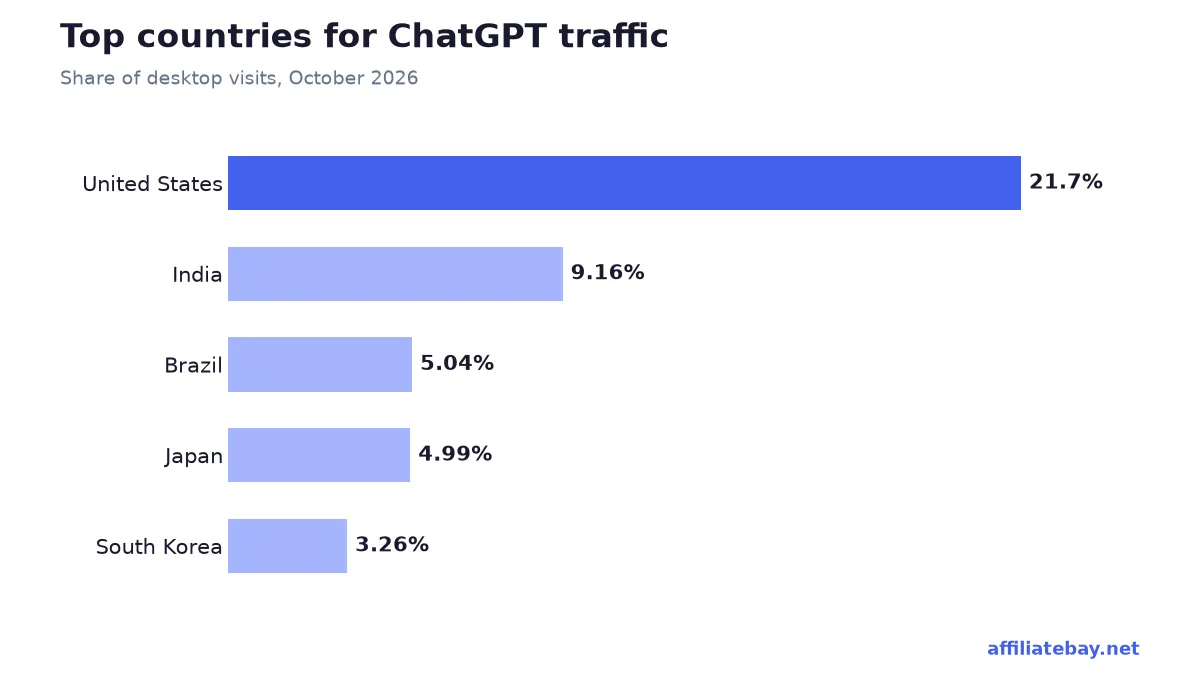
The United States sends 21.7% of ChatGPT’s desktop traffic, more than twice India’s 9.16%. Brazil, Japan and South Korea round out the top five. AI chatbot statistics by country show more than half of all traffic comes from outside that group. North America also holds 31.3% of chatbot market revenue.
What this means: India and Brazil are huge audiences. Local language content and local prices can win there.
Challenges of AI Chatbots: What Holds Them Back?
Only 27% of customers would try a chatbot again after one bad experience. AI chatbot statistics on trust show that every failed chat is costly. 87% of customers say a company using AI must offer a way to reach a human. Privacy worries also run high, and our data breach statistics show why users guard what they share.
| Challenge | Share |
|---|---|
| Customers who say access to a human is essential | 87% |
| Customers who would retry a chatbot after a bad experience | 27% |
| Service leaders with positive returns from AI | 24% |
What this means: give people an easy exit to a human, and they will come back to the bot.
Future of AI Chatbots: What Do the Forecasts Say?
The chatbot market is projected to reach $41.2 billion by 2033, about 3.5 times its 2026 size. AI agents are projected to resolve 80% of common customer service issues on their own by 2029, cutting service costs by 30%. Chat style search is growing too, with over 1 billion monthly users for AI Mode in Google Search. Ads will follow, as our digital advertising statistics show.
| Forecast | Target year | Projection |
|---|---|---|
| Global chatbot market size | 2033 | $41.2 billion |
| Common service issues solved by AI agents alone | 2029 | 80% |
| Cut in service operating costs | 2029 | 30% |
What this means: AI chatbot statistics on the future are clear: chatbots are becoming agents that act for you. Plan content for a web where AI does the clicking.
Pros and Cons of AI Chatbots 2026
Pros
- ChatGPT alone reaches 1.2 billion people a week
- Free plans exist, and paid plans start at $4.99 a month
- 58% of AI users have had it finish a task for them
- 50% of customers say AI makes service easier
- The market is worth an estimated $11.8 billion in 2026
- Revenue is projected to grow 19.6% a year to 2033
Cons
- Only 27% retry a chatbot after a bad experience
- 87% of customers still want a path to a human
- Just 24% of service leaders see positive returns
The AI chatbot statistics point one way. Chatbots are huge, cheap to try and growing fast, but trust still lags. Pick tools that solve real tasks and keep a human close by.
Quick Links
- Digital Marketing Statistics 2026
- Content Marketing Statistics 2026
- Marketing Automation Statistics 2026
- CRM Statistics 2026
- Internet of Things Statistics 2026
- Affiliate Marketing Statistics 2026
- Landing Page Conversion Statistics 2026
- Live Streaming Statistics 2026
Frequently Asked Questions About AI Chatbot Statistics
Well over a billion people use AI chatbots. ChatGPT alone has 1.2 billion weekly users, and the Gemini app has passed 1 billion monthly users. These counts overlap because many people use more than one chatbot, so they cannot be added into one total.
The global chatbot market is estimated at $11.8 billion in 2026. That is up from $9.6 billion in 2025, a rise of about 23% in a single year. AI chatbot statistics also show ready made software takes 61.8% of market revenue.
The chatbot market is projected to grow 19.6% a year through 2033. At that pace it would reach $41.2 billion, about 3.5 times its 2026 size. User growth is even faster, with ChatGPT adding 400 million weekly users in under a year.
Adults under 50 use AI chatbots the most. 66% of US adults aged 18 to 29 use them, along with 61% of those aged 30 to 49. Among adults 65 and older, use is just 23%. A third of adults under 50 use one daily.
Most AI chatbots have a free plan, and the standard paid plan costs about $20 a month. Budget plans start at $4.99 a month. Power user plans run from $99.99 up to $500 a month. For most people, the free or $20 tier is enough.
The biggest benefit is getting tasks done, not just getting answers. 58% of generative AI users have had a chatbot complete a task, and the share hits 74% in business. AI chatbot statistics also show half of customers find service easier with AI.
Trust is the biggest weak spot. Only 27% of customers would try a chatbot again after a bad experience, and 87% say a company using AI must offer a human option. One failed chat can lose a customer for good, so accuracy matters most.
Yes, AI chatbots are still growing fast. ChatGPT went from 800 million to 1.2 billion weekly users in under a year. In the US, chatbot use among adults rose from 33% in 2024 to 49% in 2026. AI chatbot statistics point to more growth ahead.
Not for every job yet. Chatbots are fast and cheap for simple questions, and 50% of customers say AI makes service easier. Still, 87% want the option to reach a human. AI chatbots work best as the first stop, with a person ready for harder problems.
How many people use AI chatbots?
Well over a billion people use AI chatbots. ChatGPT alone has 1.2 billion weekly users, and the Gemini app has passed 1 billion monthly users. These counts overlap because many people use more than one chatbot, so they cannot be added into one total.
How big is the AI chatbot market?
The global chatbot market is estimated at $11.8 billion in 2026. That is up from $9.6 billion in 2025, a rise of about 23% in a single year. AI chatbot statistics also show ready made software takes 61.8% of market revenue.
How fast is the chatbot market growing?
The chatbot market is projected to grow 19.6% a year through 2033. At that pace it would reach $41.2 billion, about 3.5 times its 2026 size. User growth is even faster, with ChatGPT adding 400 million weekly users in under a year.
Who uses AI chatbots the most?
Adults under 50 use AI chatbots the most. 66% of US adults aged 18 to 29 use them, along with 61% of those aged 30 to 49. Among adults 65 and older, use is just 23%. A third of adults under 50 use one daily.
How much does an AI chatbot cost?
Most AI chatbots have a free plan, and the standard paid plan costs about $20 a month. Budget plans start at $4.99 a month. Power user plans run from $99.99 up to $500 a month. For most people, the free or $20 tier is enough.
What is the biggest benefit of AI chatbots?
The biggest benefit is getting tasks done, not just getting answers. 58% of generative AI users have had a chatbot complete a task, and the share hits 74% in business. AI chatbot statistics also show half of customers find service easier with AI.
What is the biggest risk of AI chatbots?
Trust is the biggest weak spot. Only 27% of customers would try a chatbot again after a bad experience, and 87% say a company using AI must offer a human option. One failed chat can lose a customer for good, so accuracy matters most.
Are AI chatbots still growing in 2026?
Yes, AI chatbots are still growing fast. ChatGPT went from 800 million to 1.2 billion weekly users in under a year. In the US, chatbot use among adults rose from 33% in 2024 to 49% in 2026. AI chatbot statistics point to more growth ahead.
Are AI chatbots better than human customer service agents?
Not for every job yet. Chatbots are fast and cheap for simple questions, and 50% of customers say AI makes service easier. Still, 87% want the option to reach a human. AI chatbots work best as the first stop, with a person ready for harder problems.
Conclusion: AI Chatbot Statistics 2026 in Numbers
AI chatbot statistics for 2026 come down to three big figures. ChatGPT reaches 1.2 billion people a week. The chatbot market is worth an estimated $11.8 billion. And 49% of US adults now use AI chatbots. Trust is still the gap to close, since only 27% of customers give a failed bot a second chance. Expect chatbots to act more like agents as the market heads toward a projected $41.2 billion by 2033.